Reflections By SAKSHEE JAIMINI, and edited and co-authored by Oneworld Colab
A day on Odisha’s coast, field notes from Kendrapara, 12th August 2026
Mr Madhusmit Pati, who leads Natures Club, a local NGO in Kendrapara, traced the district’s vulnerabilities for us on a large map behind his chair. The chair itself carried another memory. Someone had made it from the wood of a tree that fell during the 1999 cyclone.
That image framed the rest of our day.
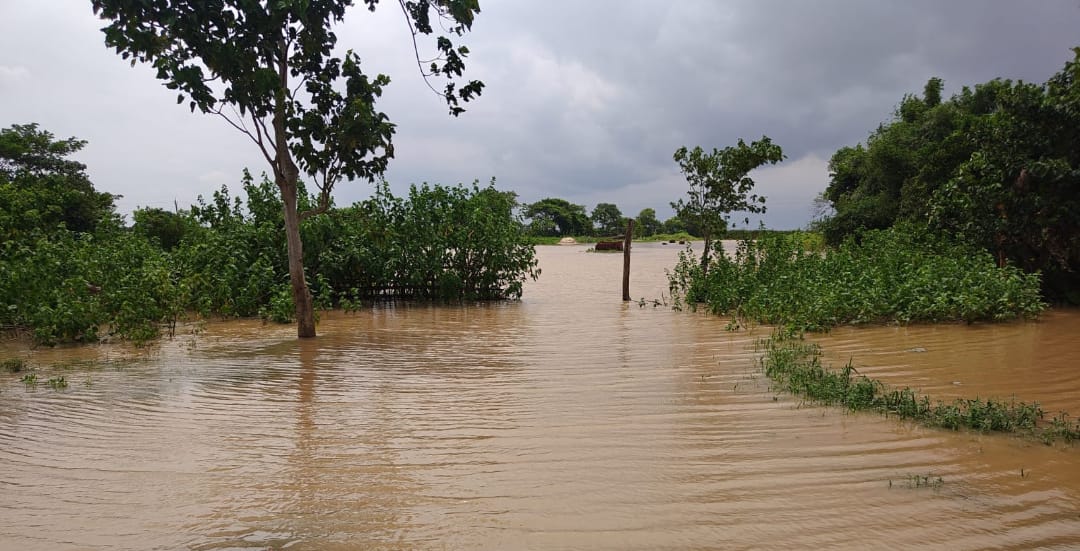
In Kendrapara, on Odisha’s coast, climate change does not always arrive as one dramatic event like cyclone. It also gathers slowly in waterlogged fields, rising salinity, swollen rivers and the narrowing distance between human settlements and crocodile habitats.
On 12th August, we left Bhubaneswar for Kendrapara to understand what these changes mean for communities living with floods, cyclones and uncertain livelihoods.
What the Chair Remembers
The super cyclone that crossed the coast near Paradip on 29 October 1999 still holds the record for the most intense storm over the North Indian Ocean. Winds touched around 260 km per hour and the storm registered the lowest central pressure the basin has seen. The state’s white paper counted 9,885 lives lost. The storm damaged crops across roughly 18.43 lakh hectares.
Odisha then built a great deal. It set up the country’s first state disaster management authority. Permanent cyclone shelters grew from 23 in 1999 to 879 by 2018, and sirens and SMS now carry warnings along the full 480 kilometre coast. When Phailin crossed in 2013 with winds above 200 km per hour, the state counted deaths in the tens. People here talk about that difference with some pride.
What None of that Reaches is the Salt
The seawater that came inland in 1999 stayed. Researchers from the International Rice Research Institute who visited this coast more than two decades later found farmers still dealing with that cyclone in their soil. The shelters answer the night. The salinity works across a generation, and it draws far less attention. The cyclone was not just history. It was a reminder of how development, disaster and responsibility remain closely linked in this landscape.
Twenty-two Women Who Came Through the Rain
Madhusmit introduced us to the Climate Warriors, known locally as the Sabuja Saathis, or Green Friends, who work under the UDAYA: Clean Future Odisha initiative. Later, in Mahakalpada, twenty-two Sabuja Saathis gathered to share their journeys. Many had traveled long distances through relentless rain. Some changed vehicles more than once to reach the meeting. I keep returning to that detail, because it tells you what the meeting was worth to them.
The landscape around us made their stories more urgent. Water hyacinth had choked the canals and made the water unusable. A crocodile rested in the shallow roadside waters. Fields lay submerged, which left many farmers unable to sow, while others transplanted paddy wherever the water stayed shallow enough.
The crocodile carries its own history. In the early 1970s, after years of hunting, surveys found only about 95 saltwater crocodiles left in Bhitarkanika. India’s Crocodile Conservation Project began there in 1975 with UNDP and FAO support, rearing hatchlings and releasing them into the creeks. The 2024 census counted 1,811, and this one district now holds around three quarters of India’s saltwater crocodiles. They live in the second largest mangrove system in the country after the Sundarbans, a Ramsar site since 2002, and those same mangroves are part of why storm surge does not always reach the villages behind them. So the conservation worked. What no one has worked out is the negotiation that comes after it: who fetches water from where, which canal a woman crosses, which route a child takes to school.
The Seed that Still Survives the Field
Farmers who once sowed by mid-July now often wait until mid-August. By the time crops begin to mature, the cyclone season has already begun. The region’s traditional paddy varieties could withstand floods and salinity, even if they produced lower yields. Many newer, higher-yielding varieties struggle with the same conditions, which exposes the limits of solutions that ignore local climate realities.
Farmers here are not the only ones who have found this. Odisha’s coastal saline belt runs five to twenty-five kilometres inland and covers over 0.25 million hectares. When IRRI tested improved salt-tolerant material in coastal fields in this region, the plants did not survive. What the team found still growing, in small pockets, were the farmers’ own landraces.
The Sabuja Saathis have taken active roles in their communities. They have led awareness programmes on reducing and reusing plastic, built new skills, continued their education and supported conservation work, including mangrove plantations in Pitapate village.
During our conversation, one woman asked a question that shifted the room. “We are doing all this for climate change. What are you doing?”
It was direct, fair and difficult to forget.
Resilience, Work and Limited Choices
In Pedchal village, the same question of responsibility appeared through livelihoods. The community welcomed us with huluhuli and chandan tika before introducing us to the Basudev Producer Group, a collective of twenty-one women who cultivate Pani Amla, a traditional red rice variety that takes 150 days to mature.
The rice yields less than newer varieties, but it suits the area’s floods and salinity better. The challenge lies in processing and marketing it. Hand-pounding and stone-grinding are their only options, so the women can process only 40 to 50 kilograms in a season. Across twenty-one households, that sits closer to subsistence than to a market. A decentralised processing unit running on renewable energy could help them turn resilience into a more viable livelihood.
An older memory sits underneath this. Through August and September, unmarried girls in these coastal districts observe Khudurukuni Osha. They fast on Sundays for the safe return of their brothers and offer khuda, broken rice, to Maa Mangala. The ritual comes from the story of Ta’poi, a merchant’s daughter whom her brothers left behind when they sailed, and it carries this coast’s maritime past with it, including boita bandana, the worship of boats, and the trade that once ran from here to Java and Sumatra.
For a long time the sea here brought the earnings, and the journey out carried the risk. That has now reversed. The sea carries the risk, and leaving is still how families earn.
Satabhaya, which takes its name from seven brothers and from seven villages the Bay had already taken, has now largely gone the same way. The sea has claimed six of them. In 2018 the district administration relocated 571 families to Bagapatia, which the state describes as India’s first rehabilitation colony for people displaced by climate. The families received homestead plots, not agricultural land. Buses now run from here to Perumbavoor in Kerala often enough to make the route a business. Reporting from Bagapatia last year described a young woman arranging flowers for Khudurukuni Osha a few months after she came back from a garment factory in Ernakulam. The ritual has outlasted the boats and the trade. What it marks now is migration for work.
Where the Mahanadi Meets the Sea
At Pitapate, the Mahanadi meets the Bay of Bengal. The view was striking. Large industrial plants stood on one side, small pockets of mangrove spread across the shoreline on the other, and the river flowed between them. Pollution from nearby industries has affected cashew yields and aquatic life, yet the factories also offer steady, year-round employment. Scientists also note that port construction along this coast has worsened erosion, because the structures obstruct the movement of sand along the shore. The same build-out employs the district and presses on its land.
On our way back to Bhubaneswar, I met one of the Sabuja Saathis at her home and asked whether people liked working in the factory. |
“Yes,” she replied. “What else can they do?”
That answer brought the day’s story back to its centre. Climate resilience is not only about surviving floods, cyclones or salinity. It is also about whether communities have meaningful choices: to farm, to fish, to protect traditional knowledge, to access clean energy, to find dignified work and to shape the development that affects them.
Kendrapara has received a good deal of protection and very little choice. It has cyclone shelters, a crocodile population brought back from near extinction, a resettlement colony that is a national first, and a bus service to Kerala. It does not yet have a way for the women in Pedchal to sell the rice that survives their fields.
The Sabuja Saathis showed us that change has already begun. Their commitment offers hope, and their question stays with us. If frontline communities are doing their part for climate action, what are the rest of us prepared to do?
Sources
[1] “The 1999 super cyclone in Odisha, India: a systematic review of documented losses”, International Journal of Disaster Risk Reduction, 2020. https://www.sciencedirect.com/science/article/abs/pii/S2212420920312929
[2] Government of Odisha white paper figure of 9,885 casualties, cited by ActionAid India. https://www.actionaidindia.org/emergency/odisha-super-cyclone/
[3] “Cyclonic hazards in Odisha and its mitigation”, Odisha Review, January 2016. https://magazines.odisha.gov.in/Orissareview/2016/Jan/engpdf/38-42.pdf
[4] “How Odisha minimised cyclone impact since 1999”, Hindustan Times, 2018. https://www.pressreader.com/india/hindustan-times-delhi/20181011/281822874756657
[5] Hindustan Times on Phailin’s wind speeds and death toll. https://www.pressreader.com/india/hindustan-times-bathinda/20180309/281908773657354
[6] “Reinventing salt-tolerant rice breeding on ground zero”, International Rice Research Institute. https://www.irri.org/news-and-events/news/reinventing-salt-tolerant-rice-breeding-ground-zero
[7] Bhitarkanika crocodile conservation history, including the 1975 UNDP and FAO project and the pre-project population estimate. A later census, for 2026, reports 1,858 individuals. https://www.sriasedu.in/news/bhitarkanika-saltwater-crocodile-conservation-2026
[8] “There are 1,811 saltwater crocodiles in Odisha’s Bhitarkanika, annual census reveals”, Down To Earth, 2024. Share of India’s population from Roundglass Sustain. https://www.downtoearth.org.in/wildlife-biodiversity/marginal-increase-there-are-1-811-saltwater-crocodiles-in-odisha-s-bhitarkanika-annual-census-reveals-93873
[9] Bhitarkanika mangroves: area and Ramsar designation, 19 August 2002. https://en.wikipedia.org/wiki/Bhitarkanika_Mangroves
[10] Saline soils of Odisha: extent and the five to twenty-five kilometre coastal strip. https://odishageography.com/soils-of-odisha/
[11] “Khudurukuni Osa: woman-centric maritime traditions of Odisha”, Nidan: International Journal for Indian Studies, 2022. https://journals.co.za/doi/10.36886/nidan.2022.7.1.4
[12] “Sea erosion is key election issue in Odisha’s Satabhaya”, Down To Earth, 2024, on the six villages lost and the 571 families relocated in 2018. On the land component of the package, see also Earth Journalism Network reporting from Bagapatia. https://www.downtoearth.org.in/climate-change/environment-in-elections-sea-erosion-is-key-election-issue-in-odisha-s-satabhaya-95707
[13] “From Odisha to Kerala, a bus of climate migrants”, Scroll.in, on the Bagapatia to Perumbavoor bus and on port construction and longshore drift. https://scroll.in/article/1048724/from-odisha-to-kerala-a-bus-of-climate-migrants
[14] “Loss of culture weighs heavy on Odisha’s migrant women”, The Migration Story. https://www.themigrationstory.com/post/reportage-1